Rock, Paper, Scissors AI!
In this lesson we use the game rock, paper scissors to investigate how an AI can recognise your hand gestures. Firstly students create, train and test their own AI model. They import their AI model into a pre-made JavaScript program to modify the computer program to incorporate game play. The level of game play will depend on the student's level of programming skills.
Additional details
| Year band(s) | 7-8 |
|---|---|
| Content type | Lesson ideas |
| Format | Web page |
| Core and overarching concepts | Digital systems, Abstraction, Specification (decomposing problems), Algorithms, Implementation (programming), Computational thinking |
| Australian Curriculum Digital Technologies code(s) |
AC9TDI8P04
Define and decompose real-world problems with design criteria and by creating user stories
AC9TDI8P05
Design algorithms involving nested control structures and represent them using flowcharts and pseudocode
AC9TDI8P06
Trace algorithms to predict output for a given input and to identify errors
AC9TDI8P09
Implement, modify and debug programs involving control structures and functions in a general-purpose programming language
AC9TDI8P10
Evaluate existing and student solutions against the design criteria, user stories and possible future impact |
| Technologies & Programming Languages | Artificial Intelligence |
| Keywords | Artificial Intelligence, AI, artificial, intelligence, teachable machine, algorithms, problem solving, Lesson idea, Lesson plan, Rock, Paper, Scissors |
| Organisation | ESA |
| Copyright | Creative Commons Attribution 4.0, unless otherwise indicated. |
Related resources
-

Crack the code - Technology Mandatory
A unit of work that develops knowledge, skills and understanding of coding
-

Python language
Students develop and implement digital solutions using Python programming language through applying data types and control structures.
-

Emerging technologies
Students follow a problem-solving process to develop an idea for applying emerging technologies to improve existing digital systems.
-

Superhighways used for millennia
In this lesson, students compare physical networks (wired and wireless) to the ancient network related to First Nations Peoples’ trading practices throughout history, including trade routes.
-

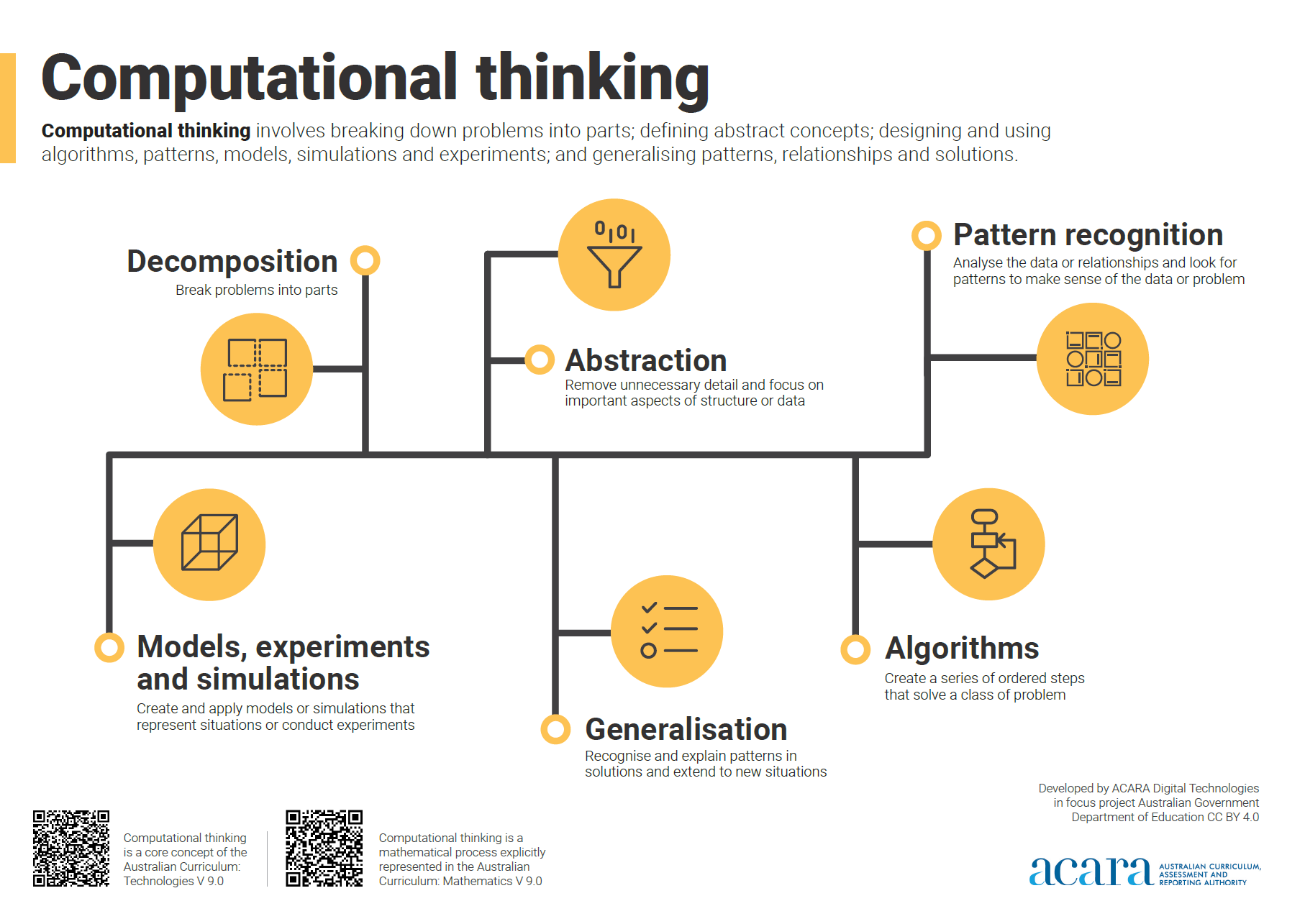
Computational thinking poster
A poster/infographic that gives a brief overview of the concepts related to computational thinking.
-

App Inventor EDU
Use this six week teaching program using a project based curriculum that allows students to explore the world of computer science through the creation of smartphone apps.
-

Classroom ideas: Micro:bit Environmental Measurement (visual and general-purpose programming) (Years 5-8)
Investigating environmental data with Micro:bits: This tutorial shows the coding needed for digital solutions of some environmental issues that can be created using pseudocode and visual programming.
-

Creating a digital start line and finish line with micro:bits (Years 7-8)
The following activity suggests one-way Digital Technologies could be integrated into a unit where vehicles are being designed and produced.