Design Thinking Process - Ideation
Students explore the design thinking process of ideation and reflect on different ways we can generate ideas in order to solve a problem with a design brief. This particular lesson explores healthy eating through the design brief although the activities can be used to ideate any design.
Additional details
| Year band(s) | 5-6 |
|---|---|
| Content type | Lesson ideas |
| Format | Web page |
| Australian Curriculum Digital Technologies code(s) |
AC9TDI6P03
Design a user interface for a digital system |
| Keywords | Think like an inventor, Ideation, Design brief, Healthy eating, Problem solving |
| Integrated, cross-curriculum, special needs | HPE, STEM |
| Organisation | ESA |
| Copyright | Creative Commons Attribution 4.0, unless otherwise indicated. |
Related resources
-

Connected cities student worksheet
Students take on the challenge of positioning mobile towers to maximise coverage across islands while minimising costs.
-

Connected cities teacher guide
This teacher guide provides background for the student challenge of positioning mobile towers.
-

Rubbish robots teacher guide
This teacher guide outlines the task for students to create an algorithm to coordinate the movements of three robots.
-

Rubbish robots student worksheet
Students create an algorithm to coordinate the movements of three robots, optimising their paths.
-

Social media age restrictions hub
Information about social media age restrictions.
-

Cybersmart Challenge
Teacher-led activities using animated videos to introduce primary school students to key online safety issues.
-

Classroom ideas: Choose your own adventure (Years 3-6)
In Digital Technologies, students from Year 3 onwards should be planning and implementing projects that include branching (decision-making). Creating a ‘choose your own adventure’ story is an excellent way for students to design and implement a project that makes use of branching.
-

Computational thinking poster
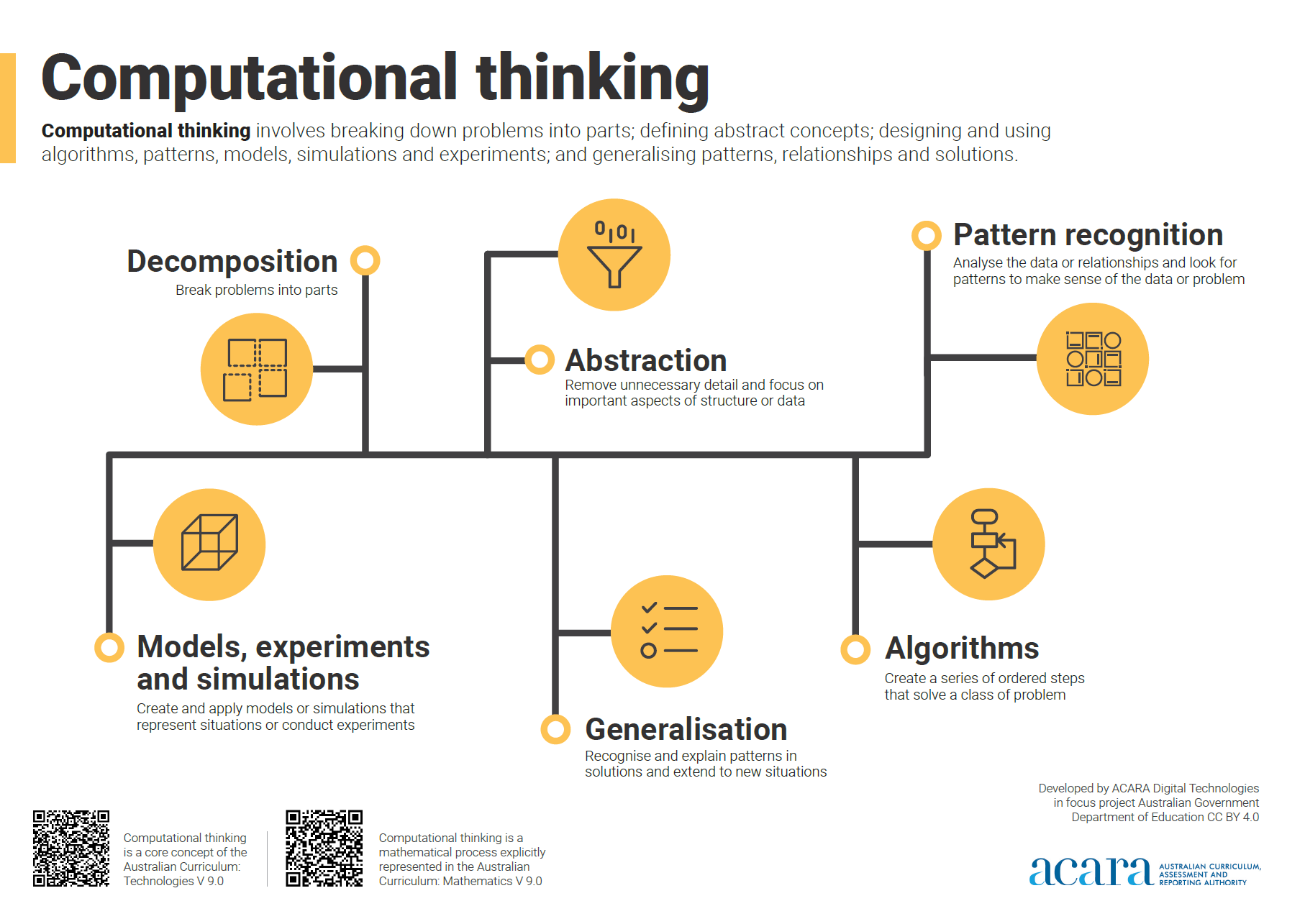
A poster/infographic that gives a brief overview of the concepts related to computational thinking.