Makey Makey Projects for Years 4-6
These lesson ideas demonstrate how to combine Makey Makey together with Scratch to create all sorts of interesting solutions with students, as well as teach the basics of circuity, conductive materials and algorithms.
Additional details
| Year band(s) | 3-4, 5-6 |
|---|---|
| Content type | Lesson ideas |
| Format | Web page |
| Core and overarching concepts | Implementation (programming), Computational thinking |
| Australian Curriculum Digital Technologies code(s) |
AC9TDI4K01
Explore and describe a range of digital systems and their peripherals for a variety of purposes
AC9TDI4K02
Explore transmitting different types of data between digital systems
AC9TDI4P04
Implement simple algorithms as visual programs involving control structures and input
AC9TDI6K01
Investigate the main internal components of common digital systems and their function |
| Keywords | Makey Makey, Peripherals, Algorithms, Visual programming, Scratch, Coding, Digital systems, Input device |
| Integrated, cross-curriculum, special needs | Design and Technologies, STEM |
| Organisation | Anthony Speranza |
| Copyright | Anthony Speranza is licensed under a Creative Commons Attribution-NonCommercial 4.0 International License. |
Related resources
-

Connected cities student worksheet
Students take on the challenge of positioning mobile towers to maximise coverage across islands while minimising costs.
-

Connected cities teacher guide
This teacher guide provides background for the student challenge of positioning mobile towers.
-

Rubbish robots teacher guide
This teacher guide outlines the task for students to create an algorithm to coordinate the movements of three robots.
-

Rubbish robots student worksheet
Students create an algorithm to coordinate the movements of three robots, optimising their paths.
-

Classroom ideas: Choose your own adventure (Years 3-6)
In Digital Technologies, students from Year 3 onwards should be planning and implementing projects that include branching (decision-making). Creating a ‘choose your own adventure’ story is an excellent way for students to design and implement a project that makes use of branching.
-

Computational thinking poster
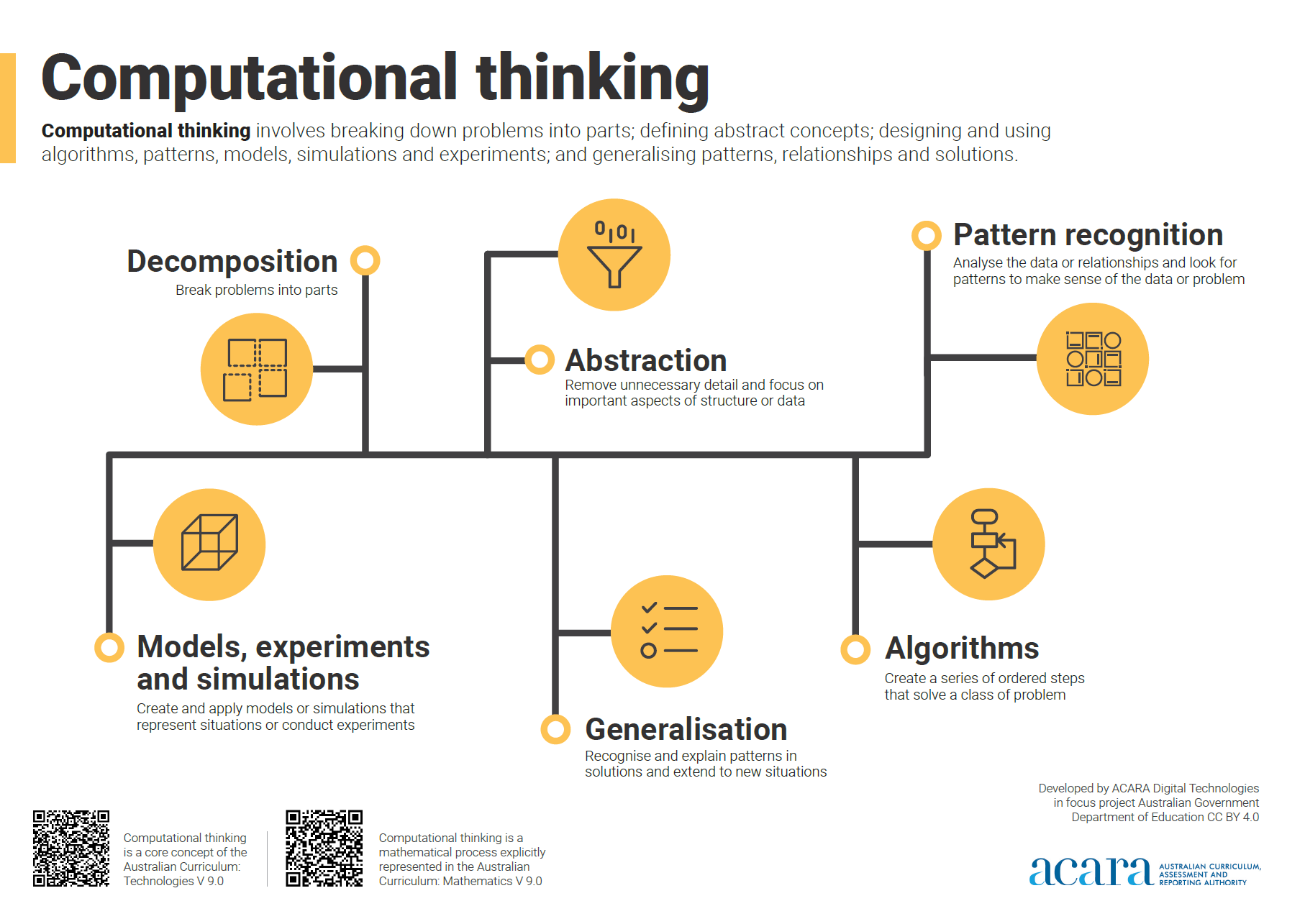
A poster/infographic that gives a brief overview of the concepts related to computational thinking.
-

Understanding digital systems (Years 3-4)
Simple ideas for learning about digital systems in the classroom.
-

Classroom ideas: Micro:bit Environmental Measurement (visual and general-purpose programming) (Years 5-8)
Investigating environmental data with Micro:bits: This tutorial shows the coding needed for digital solutions of some environmental issues that can be created using pseudocode and visual programming.