CAS Barefoot
This comprehensive collection of materials supports teacher planning and delivery of computer-programming curriculum to primary-aged students. It contains concept materials for teachers to develop computing knowledge; teaching activities for designing lessons; and downloadable files and resources to implement programming activities including software installation. Activities in this resource are largely based on Scratch, a visual programming language as well as Kodu and Hopscotch.
Additional details
| Year band(s) | 1-2, 3-4, 5-6 |
|---|---|
| Content type | Professional learning, Lesson ideas |
| Format | Web page |
| Core and overarching concepts | Computational thinking, Implementation (programming) |
| Australian Curriculum Digital Technologies code(s) |
AC9TDI2P01
Investigate simple problems for known users that can be solved with digital systems
AC9TDI2P02
Follow and describe algorithms involving a sequence of steps, branching (decisions) and iteration (repetition)
AC9TDI4P01
Define problems with given design criteria and by co-creating user stories
AC9TDI4P02
Follow and describe algorithms involving sequencing, comparison operators (branching) and iteration
AC9TDI6P02
Design algorithms involving multiple alternatives (branching) and iteration
AC9TDI6P05
Implement algorithms as visual programs involving control structures, variables and input |
| Keywords | Computer programming, Algorithms, Decision making, Design, Coding, Problem solving, Teacher learning, Kodu, Scratch |
| Organisation | BT/CAS |
| Copyright | 2014 Crown Copyright. Free-for-education material. |
Related resources
-

Connected cities student worksheet
Students take on the challenge of positioning mobile towers to maximise coverage across islands while minimising costs.
-

Connected cities teacher guide
This teacher guide provides background for the student challenge of positioning mobile towers.
-

Rubbish robots teacher guide
This teacher guide outlines the task for students to create an algorithm to coordinate the movements of three robots.
-

Rubbish robots student worksheet
Students create an algorithm to coordinate the movements of three robots, optimising their paths.
-

Computational thinking in practice F-2 (Parent and teacher activity cards)
A set of printable cards that give simple activity ideas for parents and teachers on each of the six aspects of computational thinking.
-

Classroom ideas: Choose your own adventure (Years 3-6)
In Digital Technologies, students from Year 3 onwards should be planning and implementing projects that include branching (decision-making). Creating a ‘choose your own adventure’ story is an excellent way for students to design and implement a project that makes use of branching.
-

What is a digital system and how do digital systems help us? (Years F-2)
Digital systems are all around us. Providing students with opportunities to understand what digital systems are and how people use them for different purposes is very important in the early years of schooling.
-

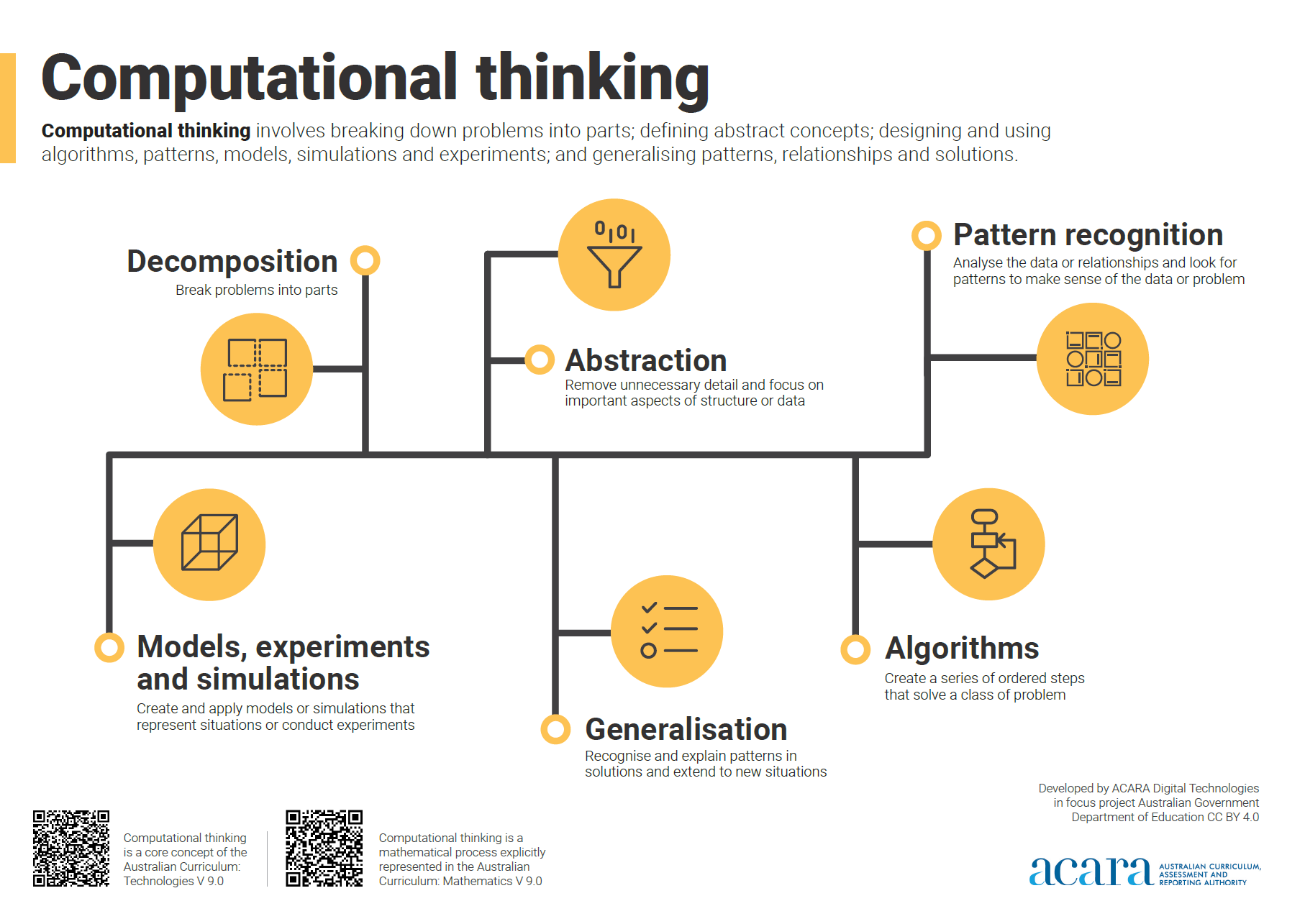
Computational thinking poster
A poster/infographic that gives a brief overview of the concepts related to computational thinking.