CS Unplugged: Artificial Intelligence
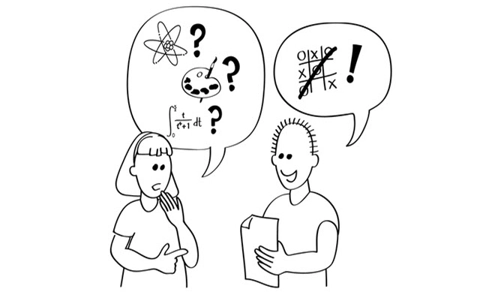
Use the The Intelligent Piece of Paper offline activity to explore the idea of computer intelligence. Through the activity students will realise that the program the computer follows is the intelligent part (which is created by a computer programmer!). Support your teaching and learning with video clips and other related resources.
Additional details
| Year band(s) | 3-4, 5-6 |
|---|---|
| Format | Web page |
| Australian Curriculum Digital Technologies code(s) |
AC9TDI4P02
Follow and describe algorithms involving sequencing, comparison operators (branching) and iteration
AC9TDI4P01
Define problems with given design criteria and by co-creating user stories
AC9TDI6P02
Design algorithms involving multiple alternatives (branching) and iteration |
| Technologies & Programming Languages | Artificial Intelligence |
| Keywords | Algorithms, Programming, Computational Thinking |
| Integrated, cross-curriculum, special needs | STEM |
| Organisation | University of Canterbury, New Zealand |
| Copyright | Creative Commons BY-NC-SA 4.0 |
Related resources
-

Digital Technologies – Two block unit planning template
This template is provided as a planning aid and can be adapted to suit individual school contexts and existing planning requirements. It offers teachers an alternative way to organise a Digital Technologies unit by separating learning into two connected teaching blocks.
-

Making games
In this sequence, students design, create and refine a 2D game in Scratch that incorporates 4-way directional movement, obstacles, rewards and broadcasts.
-

Digital footprint
In this sequence, students analyse digital footprints, data collection and online safety by exploring how personal information is created, stored and used in digital systems.
-

Networks
In this sequence, students explore the components and functions of networks, examine how data is transmitted, identify risks and evaluate security measures.
-

Design a user interface
Students design a simple user interface, create a prototype in Google Slides, and evaluate how their design meets user needs and requirements.
-

Organising data
In this sequence, students identify, match, group and create pictures, symbols, numbers and words to show the same data in different ways.
-

Teaching London Computing
Find activities for learning about Computer Science in fun ways on this site based on our underpinning Computer Science Education research.
-

Jack Changes the Game, Teacher's toolkit, Years1-3 (ages 5-8)
These lessons aim to prepare students with the knowledge and critical thinking skills to establish basic online safety.