About this lesson
The lesson follows an inquiry process in which students use a dataset to answer relevant questions about the turtle population.
Year band: 7-8
Curriculum Links AssessmentLearning hook
Sand temperature is important for turtles as the sex of hatchling turtles is determined by the temperature of the sand where the eggs incubate. Warmer temperatures will translate into more females and colder temperatures into more males. The temperature at which half of the eggs are male and half are female is called the pivotal temperature. For flatback turtles the pivotal temperature is around 28 ˚C. Scientists have placed temperature-logging equipment at flatback turtle nesting beaches across Western Australia.
The lesson follows an inquiry process in which students use a dataset to answer relevant questions about the turtle population. They consider how to analyse and display the data in order to effectively examine the impact of rising global temperatures on flatback turtle populations.
This lesson was created and developed in partnership with Pawsey Supercomputing Centre and Western Australian Marine Science Institution (WAMSI) Kimberley Marine Research Program. Turtle data was sourced from the WAMSI project, which is funded by the Western Australian State Government and research partners. Data is licensed under the Creative Commons BY-NC-SA 2.5 AU licence.
Learning intentions
- Use relevant techniques to clean up data (eg remove blank rows).
- Save, store and use CSV files.
- Use spreadsheeting software to sort and filter data, use conditional formatting, Count If function, average function, to help answer inquiry questions
- Visualise data using mapping software such as Google Maps, using latitude and longitude data
- Analyse data and look for patterns.
- Create graphs such as a bar graph to present data.
- Select the most suitable graphing format to visualise and present data.
- Use higher order thinking skills (interpreting, analysing, inferring, summarising and evaluating).
Suggested steps
Step 1
Use a relevant hook to engage students to discover more about marine turtles in particular flatback turtles.
- Use a quiz to stimulate interest in marine turtles and discussion of some key concepts.
- Use this 3D model of a flatback turtle to introduce the species. How is it similar and different to other turtle species
- A scenario could be introduced to encourage students to consider a range of issues and concerns to explore the impact of climate change. In the student task we have used the scenario: What happens to flatback turtles if the global temperature rises by 1.5°C, 2°C or more? Students could brainstorm potential issues.
Girls in Focus:
Research has shown that many girls are interested in careers that have a positive social impact. This topic shines a spotlight on a contemporary issue that requires a balance of social, ethical, economic and conservation perspectives.
Step 2
Briefly discuss students’ knowledge or experiences of climate change and what they know in particular about the impact of climate change on turtle populations. The sex of turtle hatchlings is determined by the temperature of the sand. Introduce the concept of pivotal temperature – the nest temperature at which 50% of hatchling turtles are male and 50% are female.
Step 3
Information about the datasets provided as Excel files for six sites:
- Nesting site 1: Logger 11011631 was deployed at Eco Beach (-18.27059, 122.16515). The logger is programmed to measure temperature every hour. It was deployed in the sand on 21 November 2016 and recorded data until 2 December 2018. Statistical guidance is provided.
- Nesting site 2: Logger 11023114 was deployed at 80 Mile Beach (-19.599209, 121.023961). The logger is programmed to measure temperature every hour. It was deployed in the sand on 14 November 2016 and recorded data until 13 July 2018.
- Nesting site 3: Logger 11011630 was deployed at Cape Domett (-14.79849, 128.415512). The logger is programmed to measure temperature every hour. It was deployed in the sand on 28 November 2017 and recorded data until 5 August 2018. Statistical guidance is provided.
- Nesting site 4: Logger 11023106 was deployed at Shark bay (-25.75716667, 113.6649167). The logger is programmed to measure temperature every hour. It was deployed in the sand on 3 January 2017 and recorded data until 8 January 2018.
- Nesting site 5: Logger 20213219 was deployed at Delambre Island (-20.46485894, 117.07438). The logger is programmed to measure temperature every hour. It was deployed in the sand on 26 November 2017 and recorded data until 23 November 2018.
- Nesting site 6: Logger 11000809 was deployed on Thevenard Island (-21.45675, 114.9886). It was programmed to measure temperature every hour. It was deployed in the sand on 9 December 2017 and recorded data until 15 November 2018.
Girls in Focus:
Research has shown that many girls value interaction and collaboration. Promote collaboration and recognition of the varied skills within the team, ensuring that all students are given the opportunity to manipulate the dataset.
Step 4
Depending on your students’ skills and familiarity with spreadsheeting software, such as Excel, Numbers and Google Sheets, you may decide to scaffold their introduction to the dataset or let them explore the dataset based on a question of interest.
Girls in Focus:
Girls often have poor self-confidence about mathematics, believing commonly held stereotypes that boys are naturally better than girls at maths. If you observe a number of girls showing reluctance or a lack of confidence with using spreadsheets, consider offering an additional session to practise and improve their skills. Support a growth mindset by praising their effort, strategies and behaviours.
Step 5
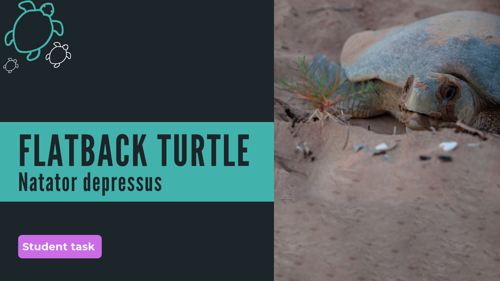
Use the Flatback turtle: Student task presentation slide deck, which provides a guide to students’ inquiry.
In many scientific endeavours the data collected is a proxy for the data we really want. In this case we have data that measures the sand temperature, but we lack actual data on the sex of the resulting hatchlings. We don’t know how long the temperature needs to be outside the viable range before the eggs die, and we don’t know how long it needs to be higher than the pivotal range before the hatchlings all become female.
We will approximate using averages and percentages, but it is important to discuss the limitations of this approach. To be more accurate, we need to understand more about how temperature affects turtle eggs and hatchlings, and we simply don’t have that data because it has not yet been studied in enough detail.
Step 6
Step 7
Start by using conditional formatting to highlight the times the data goes outside the viable range. We want to know how much of the time the temperature is outside the viable range, and how much of the time the nest temperature will produce only males, or only females. As a class, discuss how best to display this data. One technique is to use conditional formatting.
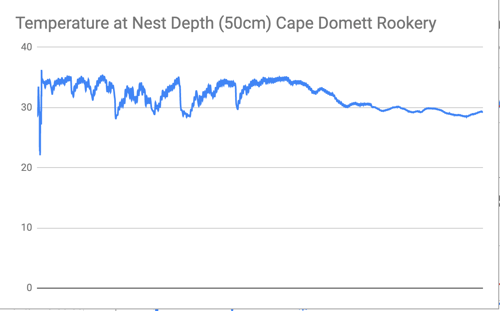
- Start with a line graph to show the change in temperature over time.
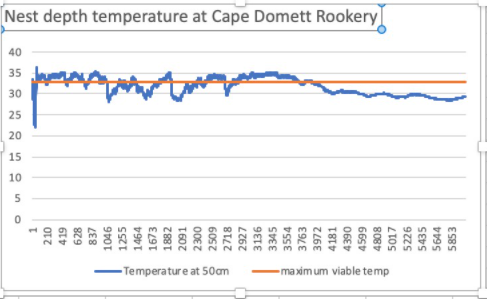
- Now add in a line to show the 33°C maximum viable temperature. The simplest way to do this is to create a column of all 33s, as long as the column of temperatures, and then graph the two columns together as line graphs.
Step 8
Discuss setting appropriate labels for both of the lines as well as a meaningful title for the graph as a whole. Note that the simplest way to label the lines well is to change the heading labels for those columns in the spreadsheet.
Step 9
Ask students: What kind of graphs might you use to show the amount of time hatchlings will be: non-viable, male only, a mix of male and female, and female only?
Discuss as a class what you are trying to convey with this graph, and what the best type of graph would be to show this. Student may suggest a pie chart (circle chart), used for showing data as a percentage. For this exercise compare the same data presented as a bar chart and a pie chart and discuss the benefits and limitations of each.
As with all forms of communication, the important questions are: What are you trying to say? and What do you want the reader to understand from this graph?
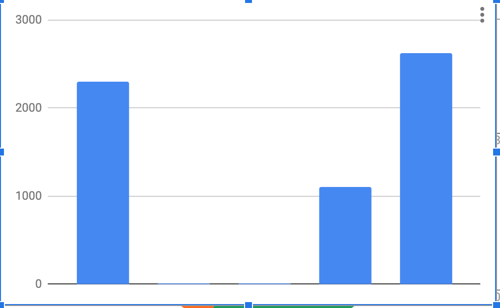
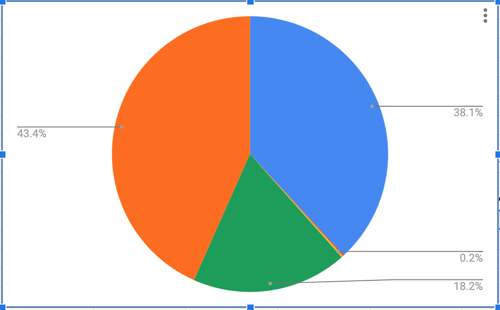
As a class, discuss labelling of the charts and how this helps understanding. Make sure the students’ charts have titles, labels on each of the parts of the graph and legends. Also discuss how the big variations in values (for example the limited values for ‘males only’ in the Cape Domett data) make some of the sections of the chart difficult to read.
Step 10
Step 11
Ask the class groups for each nesting site to construct graphs that show:
- What percentage of time is the sand at a viable temperature for flatback turtle hatchlings?
- What percentage of time is the sand at, or close to, the pivotal temperature?
- When is the most suitable month or months for turtles to nest at the particular location?
Step 12
Provide an opportunity for groups to share their results so that each group can compare results and graphs for both nesting sites. Discuss different ways the data has been represented, considering the advantages and disadvantages of each technique.
Step 13
Apply what students have found
Using the results and graphs, students highlight the turtles’ plight, and the effect of a 2°C increase in global temperature. They can create an infographic, video or slide presentation to inform or persuade the public to care more about climate change.
Design a digital solution
Girls in Focus:
Research suggests that many girls are motivated when they are given opportunities to approach projects their own way, exercising their personal preferences and creativity. Engaging with creative problem-solving also encourages students to embrace failure as part of the learning process, building resilience.
Why is this relevant?
Acquire data
Acquiring data is how we collect and access data from a variety of sources. Students can generate data of various types through their own experiments and investigations.
Store data
Record data in a format that allows it to be easily accessed or obtained. Students can describe how the data they have acquired can be stored in different ways using different representations and/or software. It is important to select the most suitable representation.
Organise data
Organising data relates to the ways we order, sort and arrange data to assist us with interpretation in different contexts.
Interpret data
Use data and its characteristics, properties and patterns to form a conclusion or derive meaning from it. Students can work with data that requires some simple processing using software. This could be in the form of simple spreadsheet calculations or using data in code. Students draw conclusions about the data as a result of this processing.
Resources
Datasets
- Logger turtle data - Eco Beach (xlsx file)
- Logger turtle data - 80 mile beach (xlsx file)
- Logger turtle data - Shark Bay (xlsx file)
- Logger turtle data - Delambre Island (xlsx file)
- Logger turtle data - Cape Domett (xlsx file)
- Logger turtle data - Thevenard (xlsx file)