
Visible Thinking
Use this website to encourage the development of a culture of thinking in classrooms and schools. The site provides a useful way to learn about Visible Thinking as well as thorough descriptions of the ideals, routines and activities that have been developed through research in schools.
Additional details
| Year band(s) | 7-8, 9-10 |
|---|---|
| Content type | Article or research, Professional learning |
| Format | Web page |
| Australian Curriculum Digital Technologies code(s) |
AC9TDI6P07
Select and use appropriate digital tools effectively to create, locate and communicate content, applying common conventions
AC9TDI8P08
Generate, modify, communicate and evaluate alternative designs
AC9TDI10P08
Generate, modify, communicate and critically evaluate alternative designs
AC9TDI10P05
Design algorithms involving logical operators and represent them as flowcharts and pseudocode
AC9TDI10P09
Implement, modify and debug modular programs, applying selected algorithms and data structures, including in an object-oriented programming language |
| Keywords | Thinking, Visible thinking, Creativity, Maps, Charts, Strategies, Collaboration, Cooperation, Critical and creative thinking, Literacy, Personal and social capability |
| Integrated, cross-curriculum, special needs | Critical and creative thinking, Personal and social capability |
| Organisation | Harvard Project Zero |
| Copyright | CC BY-NC 4.0 |
Related resources
-

Critical thinking: Deciding what to trust in a world of AI, scams and fake news
Find out how you can use critical thinking to work out what’s real, true, safe and responsible.
-

AI companions: information sheet
Information about risks of AI companions that are designed to simulate personal relationships.
-

Abstraction
Want to find out more about what abstraction is and its role is in computational thinking? This resource outlines: What is abstraction, why is abstraction important and what abstraction looks like in the primary curriculum. Requires free log-in to access resources.
-

GenAI readiness and implementation modules
As generative AI (GenAI) becomes an increasingly important tool in education, it's essential for teachers to understand both its potential and its limitations. This two-module offering equips teachers with the knowledge and practical skills to use GenAI tools like Copilot effectively in the classroom. Teachers will enhance their own digital literacy while learning how to guide students in using AI responsibly and thoughtfully. By focusing on teacher readiness and practical classroom strategies, the modules support the development of students who can navigate AI in both classroom and everyday contexts. The modules were developed in collaboration with Microsoft.
-
Teaching London Computing
Find activities for learning about Computer Science in fun ways on this site based on our underpinning Computer Science Education research.
-
Books for exploring Digital Technologies concepts
Use these suggested books or similar to identify and discuss key concepts, key ideas and related ways of thinking about Digital Technologies.
-
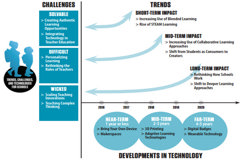
NMC Horizon Report
This report profiles the trends and key technologies and practices shaping the future of teaching and learning, and envisions a number of scenarios for that future. It is based on the perspectives and expertise of a global panel of leaders from across the higher education landscape.
-
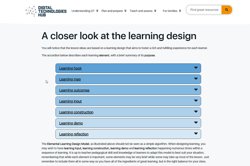
Lesson learning design
The Elemental Learning Design Model has been used to design our lesson plans. This module includes key components to design effective learning opportunities including, learning hook, learning input, learning construction, learning demo and learning reflection within a sequence of learning.